

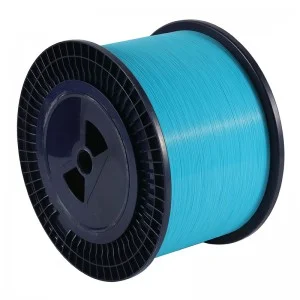
G.655 single-mode fiber intended for metropolitan and access networks. Consult the manufacturer for the specific subclass and full specifications.
Manufacturer: Nanjing Wasin Fujikura
Technical Specifications
Values and units are based on the manufacturer’s published information.
| characteristic | condition | date | unit | |
| Optical specifications | ||||
| Attenuation coefficient | 1550nm 1625nm |
≤0.22 ≤0.24 | dB/km dB/km |
|
| Attenuation vs.Wavelength | @1550nm | 1525~1575nm | ≤0.02 | dB/km |
| Wavelenth Dispersion | 1530-1565nm 1565~1625nm |
2.0~6.04.5~11.2 | ps/(nm·km) ps/(nm·km) | |
| Zero-dispersion wavelength | ≤1520 | nm | ||
| Zero-dispersion slope | 1550nm | ≤0.084 | ps/(nm 2·km) |
|
| Polarization Mode Dispersion PMDSingle fiber maximal valueFiber link value (M=20,Q=0.01%) | ≤0.20 ≤0.10 | ps/√kmps/√km | ||
| cable cutoff wavelength | ≤1450 | nm | ||
| Mode field diameter MFD | 1550nm | 9.6±0.5 | μm | |
| Effective Group Index of Refraction Neff | 1550nm 1625nm |
1.4691.469 | ||
| Point discontinuity | 1550nm | ≤0.05 | dB | |
| Dimensions performance | ||||
| Cladding diameter | 125±0.7 | μm | ||
| Cladding Non-circularity | <1.0 | % | ||
| Outer coating diameter | 245±10 | μm | ||
| Cladding/Coating Concentricity | ≤12.0 | μm | ||
| Core/cladding concentricity | ≤0.6 | μm | ||
| curvature(radius) | ≥4 | m | ||
| length | 2.0~50.4 | km/reel | ||
| Environmental performance(1310nm/1550nm)nm/1550nm) | ||||
| Damp heat | 85℃, humidity≥85%, 30days | ≤0.05 | dB/km | |
| Dry heat | 85℃±2, 30days | ≤0.05 | dB/km | |
| Temperature Dependence | -60℃ ~+85℃,two weeks | ≤0.05 | dB/km | |
| Water immersion | 23°C±5°C, 30days | ≤0.05 | dB/km | |
| Mechanical performance | ||||
| Proof test level | ≥0.69 | GPa | ||
| Macrobend loss100 turns φ60mm1 turns φ32mm | 1625nm 1550nm |
≤0.1 ≤0.05 | dBdB | |
| Strip force | 1.0~5.0 | N | ||
| Dynamic fatigue parameter | ≥20 | |||
G.655 Single-Mode Fiber Overview
G.655 single-mode fiber belongs to the non-zero dispersion-shifted fiber (NZ-DSF) family. It is designed for transmission systems in which dispersion management across telecom wavelength bands is an important part of the link design, including selected DWDM architectures. Its suitability depends on the transmission system, link length, channel plan and optical equipment. The G.655 designation alone does not establish that a fiber is suitable for every DWDM or long-haul application.
This product is supplied by Nanjing Wasin Fujikura. The table on this page presents published family-level specifications. Confirm the exact G.655 subcategory and orderable product version against the latest manufacturer datasheet before procurement.
G.655 vs. G.652D: What Is the Difference?
G.652D and G.655 fibers have different dispersion characteristics around their intended operating wavelength regions. G.655 fibers use a shifted zero-dispersion wavelength while maintaining non-zero dispersion, which can support dispersion planning in certain multi-channel transmission designs. This does not make G.655 universally better: G.652D remains a common and cost-effective choice for many general-purpose, metropolitan and access networks.
The correct choice depends on the optical line system, channel wavelengths, amplifier spacing, power budget and the engineering design of the complete route. Compatibility with existing fiber infrastructure and installed equipment should also be checked before introducing a different fiber type.
Applications of G.655 Fiber
- Metropolitan and long-haul transmission: where dispersion characteristics are part of the optical link design.
- DWDM systems: where channel spacing, launch power and nonlinear effects must be considered together.
- High-capacity optical links: when the fiber specifications match the transmission equipment and engineered link budget.
- Network expansion projects: when compatibility with the existing infrastructure and project requirements has been confirmed.
G.655 Fiber Selection and Technical Checklist
Before ordering G.655 single-mode fiber, request confirmation of the following items from the manufacturer or supplier:
- The exact G.655 subcategory and the datasheet revision for the offered product;
- Attenuation and dispersion values at the wavelengths used by the project;
- Mode-field diameter (MFD), cable cutoff wavelength and PMD specifications;
- Coating diameter, delivery length per reel and packaging conditions;
- Mechanical and environmental test results and quality-control requirements;
- Compatibility with the transmission equipment, splicing process and installed fiber route.
The technical table is useful for an initial review, but final engineering and bulk procurement should use the current datasheet for the exact subcategory and order code. If catalogue revisions differ, the specification confirmed in the quotation and order documentation should govern the supply.
Compare G.655 with Other Single-Mode Fibers
For general transmission and access networks, also review G.652D fiber. Where bend tolerance is a key requirement, compare G.657 A1 and G.657 A2. The final selection should follow the project specification rather than the fiber family name alone.
Wasin Fujikura Catalogue and Quotation
For the wider product range and manufacturer information, consult the Nanjing Wasin Fujikura Products Catalogue (PDF). To request pricing and lead time, provide the required G.655 subcategory, total length, reel quantity and delivery destination so the offered version can be checked against your project requirements.