

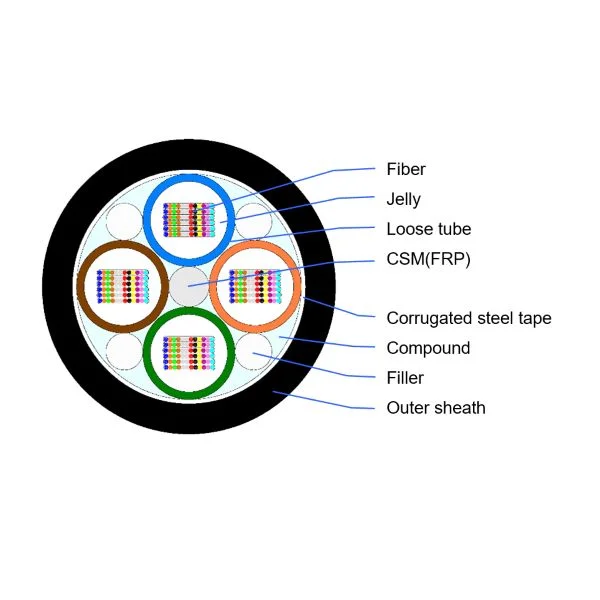
Non-metallic strength member loose tube stranded fiber ribbon cable with steel tape armored PE sheath (GYFDTS).
Manufacturer: Nanjing Wasin Fujikura
Cable Construction
Fiber ribbons sit in stranded tubes around an FRP member, protected by steel tape and a polyethylene sheath.
Operating Conditions
- Operating temperature: -40 °C to +70 °C
- Bending radius: static 10 × D; dynamic 20 × D (D is cable diameter)
Technical Specifications
Values and units are based on information published by the manufacturer.
| Fiber Count | No. of (Tubes+fillers) |
Max Ribbonrs Per Tube | Nominal Diameler (mm) | Nominal Weight (kg/km) | Allowable Tensile Load(N) (Short term/long term) |
Allowable Crush Resistance(N/10cm) (Short term/long term) |
|
| 6-Fiber Ribbon | 12~120 | 5 | 4 | 16.6 | 271 | 1500/600 | 1000/300 |
| 126~180 | 5 | 6 | 16.6 | 271 | |||
| 186~288 | 6 | 6 | 20.4 | 414 | 2200/600 | ||
| 12-Fiber Ribbon | 24~360 | 5 | 6 | 20.4 | 387 | 2200/600 | 1000/300 |
| 372~576 | 5 | 12 | 23.5 | 550 | |||
| >600 | Available upon customer’s request | ||||||
Additional technical details
The fiber ribbons are housed in high-modulus plastic loose tubes, with water-resistant filling inside and outside the tubes. Tubes and fillers are stranded around a high-modulus dielectric FRP rod, optionally coated with polyethylene, to form a compact circular core. Plastic-coated steel tape is wrapped around the core. An outer polyethylene sheath is extruded over the core. Full-section water blocking and tube gel protect against moisture; flexible tubes are easy to route in closures, and the cable provides mechanical and temperature performance. The jacket protects against UV, fungus, abrasion and other environmental factors. High fiber density supports easier identification and maintenance and can reduce installation cost. The manufacturer states a service life above 30 years with controlled production and materials. For access and building communications, installed in ducts or aerially; operating temperature −40 to +70 °C; bending radius 10 × diameter static and 20 × dynamic.